
With Karnataka facing acute scarcity of drinking water and fodder due to deficient monsoon rains, new Chief Minister Jagadish Shettar on Tuesday met Prime Minister Manmohan Singh and sought an immediate Central assistance of Rs 2,000 crore to tackle the situation.
The Cauvery monitoring committee, headed by Water Resources Secy DV Singh, met on Monday morning.
Inflation data for June has not brought any cheer to the markets. From this data, the possibility of a rate cut is negligible. Deficient monsoons and higher food prices would make any rate action difficult.

The IMD said that rainfall over India in August and September would be around 106 percent of the long-period average of 422.8 mm.

Foodgrain output stood at 129.94 million tonnes (mt) in last year's Kharif season.

Total area sown till last Friday was 16.56 mn hectares, up 23%.

Prime Minister Manmohan Singh on Saturday said the Centre and states should not hesitate to take strong measures, including against hoarders and black marketeers, to check the spiraling prices of essential commodities in the wake of delayed and deficient monsoon."In short, the contingency plan for crops, drinking water, human and animal health, fodder, etc should be brought into operation without delay and a close watch kept on availability of foodgrains," he said.

This year, the monsoon was above normal in almost all parts, except in North-West India, which comprises the major grain producing states of Uttar Pradesh, Punjab, Haryana, Rajasthan, along with states such as Himachal Pradesh, the NCR, Uttarakhand, and J&K.
Delay in monsoon has affected the sowing operations of various crops during the kharif season, reducing the acreage of these commodities this year.

India recorded around 16 per cent more rainfall than normal in August, with rainfall over Northwest India recorded at 253.9 mm, the second highest in August since 2001, the India Meteorological Department (IMD) said on Saturday.

"Despite the global economic crisis, we grew by 6.7 per cent last year...This year, we are getting mixed signal," Mukherjee said, while noting that indicators are coming good from industrial production data and in terms of business demand and investor confidence.
With deficient monsoon reducing hydropower generation in the country by around 40 per cent, the power ministry has started stressing more on power from coal and natural gas.

The Tamil Nadu government has said it was largely dependent on ground water to meet requirements till the onset of north east monsoon in October.

East India, along with a major portion of central India, is likely to be at a higher risk of being rain deficient, especially during the first half of the season.

However, it's too soon to see any trend; July rain is key.

Prices of food articles continued to rise over the previous week. Bajra and urad prices rose by two per cent each, and condiments and spices, arhar, and fruit and vegetables became more expensive by one per cent.

It has also advanced into most parts of Tamil Nadu, some parts of south interior Karnataka and remaining parts of south Bay of Bengal, according to IMD.

The outlook of a negative growth in agriculture comes on the back of the Indian Meteorological Department's revised rainfall forecast and uncertain impact of mitigants such as ground water harvesting and modification of cropping patterns.
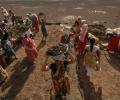
Around 40 per cent of the country is staring at drought-like conditions ahead of the monsoon as water levels have receded sharply.

The load-shedding has been in force for the last several months as the water level in reservoirs depleted drastically due to deficient rainfall last year.

El Nino is expected to occur in August-September, but it is unlikely to have any major impact on the monsoon, and the weatherman expects a positive Indian Ocean Dipole, which has a strong influence on rainfall in the country.

Sowing had started on a sluggish note in several parts of the country because of delay in the onset of the monsoon but has picked up pace subsequently as the rains progressed and performed appreciably well in August.

Heavy rain in the first week of July compensated for the shortfall but caused flooding in many northeastern states.
Surging oil prices, deficient monsoon and the Tsunami disaster last year notwithstanding, business confidence has inched its way up to its highest level since December 1995, economic think tank NCAER said on Monday.

The central bank, however, warned that the downside risks to growth could play out if global recovery slows.

According to Skymet Weather, the initial surge in the Monsoon rains can be attributed to the transition of El Nino into the neutral phase.

Reports said that in Telangana and Karnataka, excessive rains the past 10 days has threatened the standing green gram and maize crops and could negatively impact yields if the skies don't open up. But in the north-west and central parts of India, the resurgence of monsoon could not have come at a better time as oilseeds and pulses crops would otherwise had weathered if the rains didn't revive in August.

The government on Thursday said it will not allow prices of essential food items to increase due to the impact of possible deficient monsoon this year.

Several global models are predicting El Nio to appear around the second half of the year, which are the crucial rain-bearing months.

All sub-regions have been receiving good rainfall except the North-east and east region of the country, where the deficiency has reached 23 per cent.

Southwest monsoon hit Kerala on Friday marking the start of the rainy season, four days after its normal onset date.

After a making a slow progress, the southwest monsoon is expected to gain momentum and advance further into several parts of drought-hit Maharashtra and central India.

Agriculturally important UP, MP, Haryana, Maharashtra, and Punjab received 20-30% shortfall in rain

Officials said good rain in August - though it might not improve acreages much for most crops except urad, moong, and paddy - would help in improving yields in the crops already planted.

Domestic-focused agricultural chemical (agrochem) companies could face near-term headwinds, given the worries on the El Nio effect on monsoons, higher inventory, and pressure on margins. Some of these were reflected in the October-December quarter (third quarter, or Q3) results of companies and may impact them in the current quarter (fourth quarter, or Q4) as well. Nuvama Research pointed out that the sector witnessed mixed performance during the quarter as global agrochem and domestic fertiliser companies maintained growth momentum, while adverse agronomical conditions and excess channel inventory weighed on domestic market volume offtake.

With rainfall and monsoons becoming highly unpredictable partly due to climate change and partly due to usual changes in weather patterns, it is such innovations by IMD which will help in planning better, reports Sanjeeb Mukherjee.

The total rainfall till now is not only deficient, but is also erratic in terms of both geographical spread and timings.

The forecast of deficient monsoon rainfalls scared farmers.
